


These are a few questions I see periodically, so I've made the answers into a post for everyone to enjoy. Names may have been changed to protect their identity.
Hello,
I'm preparing to order two custom floating shelves and had a few questions about the LED channel preparation before placing my order.
I understand the routed channel dimensions are 11/16" wide × 5/16" deep, and that the channel stops approximately 1" from each end of the shelf.
Could you please clarify the following?
Is the routed channel designed to accept a standard aluminum LED extrusion with a snap-in frosted diffuser, or is it intended for the LED strip to be adhered directly into the routed groove?
If it is designed for an aluminum channel, do you have a recommended manufacturer, model, or profile dimensions that fit your routing perfectly?
Do you have any recommended COB LED strip specifications (width, voltage, etc.) that work best with your channel preparation?
If I choose one LED channel located 2" from the front edge on the bottom of the shelf, is that the configuration you typically recommend for illuminating a backsplash and displaying bottles and glassware?
Thank you for your help. I'm looking forward to placing my order and want to make sure I select the proper lighting components from the start.
Best regards,
Tom
Hi Tom,
Thank you for your message.
The channel we cut is for use with typical sticky back 12V tape lights, nearly all of them from most manufacturers is about ½" wide tape lights. The plastic lens/cover we include press fits to the wood channel. Ours doesn't involve an aluminum extrusion. If you want a different size channel to fit an extrusion you prefer to use let me know, I am sure we can accommodate you. Keep in mind the limitation is 5/16" deep on the 1.75" shelves before it's in the space of the steel bracket.
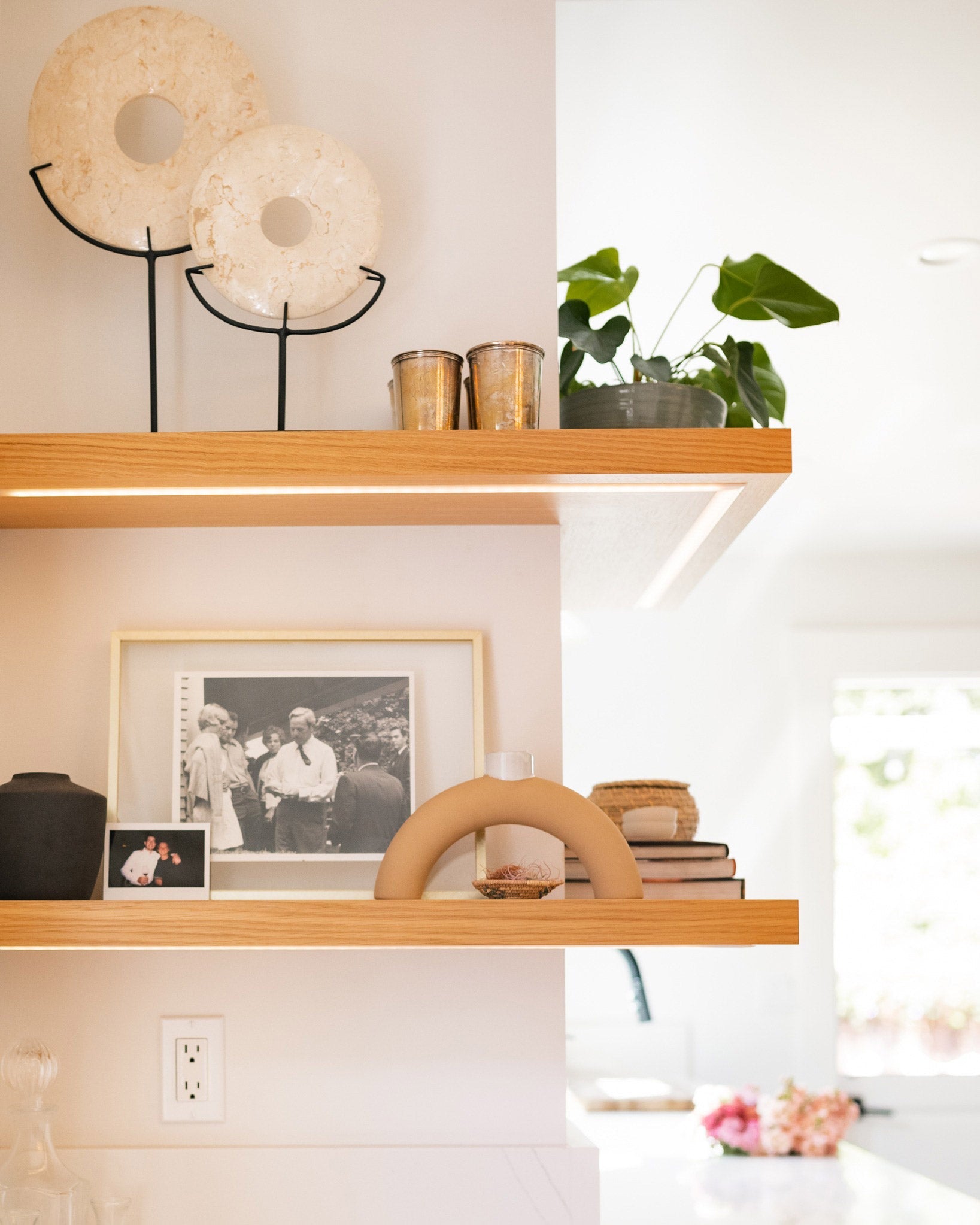
2" from the front edge on the bottom is the most typical position for lights to cast an even cone of light on a countertop.
There is more detail on the LED channels here:
Please let me know if there's anything else.
Thank you again for your detailed responses. They've been extremely helpful, and I think I'm getting very close to placing my order.
I have just a few final questions:
-
Stemware Rack Installation
I plan to install two under-shelf stemware racks on the underside of the lower shelf (similar to the photo shown on your website). Could you let me know where the concealed steel support brackets are located so I can avoid them when mounting the racks? If you have a recommended mounting area or spacing, I'd appreciate your guidance.
-
Teak Veneer
Could you tell me a little more about the teak veneer you use? Specifically:
Is it plain sliced, quarter sliced, or rift cut?
Approximately how thick is the face veneer?
Is the front edge finished with a solid teak edge band or another type of edging?
-
Weight Capacity
Since these shelves will be used in a home bar, I'd like to understand their practical load capacity. Assuming the shelves are properly installed into wall studs using your supplied concealed brackets, what is the recommended maximum evenly distributed load for a 76" × 12" × 1.75" shelf?
In addition to the overall weight capacity, should I avoid placing particularly heavy items (such as decanters or multiple liquor bottles) in specific areas of the shelf, or is the load intended to be distributed evenly across the entire length?
Thank you again for all of your assistance and excellent customer service. I really appreciate your willingness to answer my questions, and I'm looking forward to placing my order.
Best regards,
Tom
Hello again Tom,
For a shelf as you describe we make a steel bracket 10 x 73" with 4 arms on it. The arms on the end are 3" inset from the ends, the other two are evenly spaced between. By the way, here is the link for the stemware racks you mentioned.
We select plain-slice veneer for the top and bottom and quartered material for the edges however this is not a strict specification. The veneer is thin, I can't think of the inch dimension but it's a small number. If I didn't have the 25 years' experience working with this kind of material I might question it. Not to worry, even though it's not very thick it looks fantastic and holds up very well.
The most important thing about veneer with regard to durability is how well is it bonded to the substrate and the quality of the seams. In our case we use the most expensive German glue so its bonded really well. The quality of the seams comes down to workmanship and process, which for us, we have the right machinery and craftsmanship to create the tight seams that are nearly imperceptible.
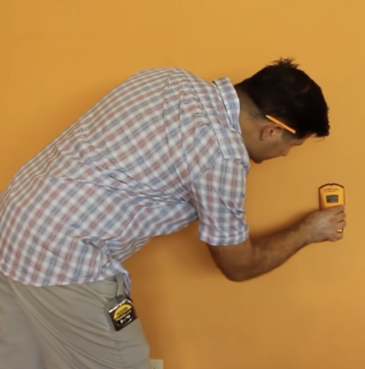
The shelves are very strong though the installation is the critical point. As long as you are attaching to wood studs and you follow our installation guide correctly you can put all of your bottles and borrow some of your neighbor's bottles to load up on any part of the shelves you like. Anytime I install a shelf I am only happy with the installation if I feel like I could stand on it:


Leave a comment
This site is protected by hCaptcha and the hCaptcha Privacy Policy and Terms of Service apply.